Packaging Insights for Custom Poly Bags and Flexible Packaging
Food Packaging Safety Starts With the Intended Application
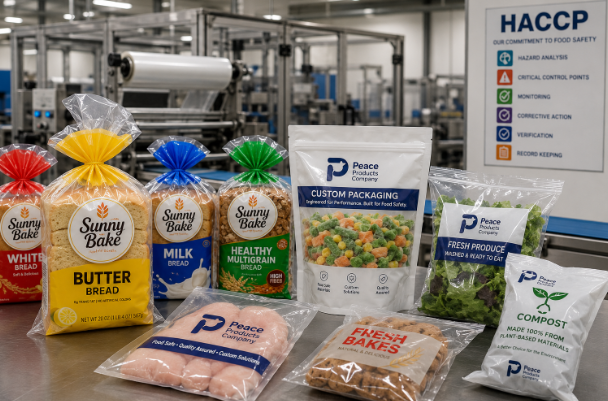
Food packaging requirements vary because different products place different demands on their packaging. A frozen food product, for example, may require packaging suited to low temperature storage, while another product may require a specific seal, ventilation, or handling configuration.
The FDA evaluates food contact substances according to their intended use and applicable conditions of use. These conditions can include the type of food, temperature, duration of contact, and how the packaging will be used.
For food manufacturers, the first step is therefore to define the application clearly. The food product, intended contact, storage conditions, sealing method, handling requirements, and packaging process should all help determine the final bag specification.
How Custom Specifications Support Package Integrity
Unlike a stock bag with predetermined specifications, a custom poly bag can be configured around the requirements of the food product. This allows manufacturers to address specific conditions that could affect package integrity during filling, sealing, storage, handling, and distribution.
Depending on the food product and packaging requirements, these specifications may include:
- Material selection appropriate for the intended food contact application
- Bag thickness and strength based on product weight, shape, and expected handling
- Dimensions that provide an appropriate fit for the product
- Seal or closure requirements suited to how the package will be closed
- Venting or perforations when the application requires airflow or moisture management
- Bag construction based on how the product will be filled, handled, stored, and packaged
The food safety advantage comes from matching these specifications to the application. A bag with the appropriate material, strength, fit, and closure is better positioned to maintain its integrity throughout its intended use than a stock bag that was not selected for those specific conditions.
Peace Products offers multiple bag constructions, including flat, gusseted, wicketed, vented, and resealable configurations. Its manufacturing capabilities also include different films, punches, die cuts, venting, adhesive features, and other options that can be incorporated based on the packaging application.
Manufacturing Procedures Are Part of Food Packaging Safety
A custom poly bag can be appropriately specified for a food application, but food packaging safety also depends on the conditions and procedures used while that packaging is manufactured.
Potential contamination risks can arise while packaging materials are stored, converted, handled, and prepared for shipment. Sanitation practices, employee hygiene, material storage, facility conditions, handling procedures, and documented food safety programs can help control these risks before finished bags reach the food manufacturer.
Peace Products is audited by AIB International, with its food safety information identifying areas including Good Manufacturing Practices, HACCP, sanitation, facility design, food packaging storage, and employee hygiene.
HACCP provides a preventive framework for identifying and controlling biological, chemical, and physical hazards. The U.S. Food and Drug Administration explains HACCP as a system centered on hazard analysis, critical control points, monitoring, corrective actions, verification, and documentation.
For packaging manufacturers, applying these controls throughout production helps address potential risks before the packaging reaches the food manufacturer. This makes manufacturing practices an important part of the broader food packaging safety process
Selecting Food Packaging With Safety in Mind
Custom poly bags support food packaging safety when their materials, construction, strength, closure, and other specifications are matched to the food product and its conditions of use. Manufacturing practices also matter because packaging materials need to be stored, handled, converted, and prepared for shipment with potential contamination risks in mind.
For food manufacturers, clearly defining the application before production provides a stronger foundation for selecting an appropriate bag specification.
If you are evaluating a custom poly bag for a food packaging application, contact Peace Products to discuss your product and packaging requirements.
Frequently Asked Questions
Not necessarily. Differences in product weight, shape, temperature, storage conditions, sealing requirements, and handling can affect the material, thickness, dimensions, and construction needed for the application.
What information does your team need before recommending a bag construction for a food packaging application?
Useful information includes the product being packaged, intended food contact, dimensions, film and thickness requirements, filling and sealing process, storage conditions, quantity, printing requirements, and any special features. These details can help determine whether a flat, gusseted, wicketed, vented, rollstock, or another construction is appropriate for the application.
What commonly causes problems when a bag reaches the filling or packaging line?
Problems can occur when the bag specification does not match the product or packaging process. Incorrect dimensions, unsuitable construction, inadequate strength, incompatible closures, or an inappropriate bag format can affect package integrity and may require the specification to be revised.
Comments (0)