Packaging Insights for Custom Poly Bags and Flexible Packaging
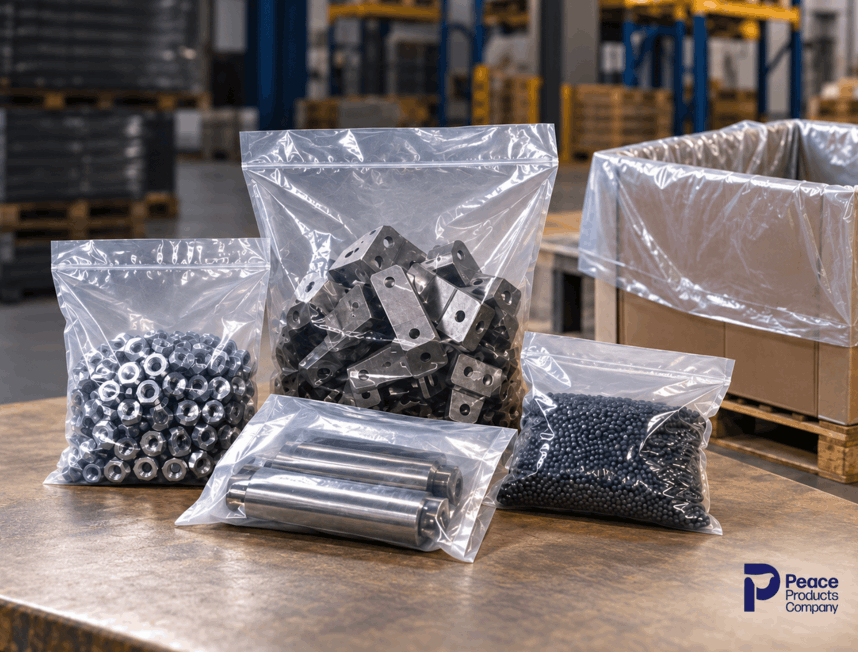
Heavy duty poly bags are used when industrial products create more stress than standard packaging can reasonably handle. Weight, sharp edges, abrasion, movement during shipping, and pressure against seals can all affect performance.
Choosing the right industrial polythene bag is therefore not just a matter of buying thicker film. The specification should account for film gauge, product geometry, bag construction, fit, seal location, handling, and the role the bag plays within the complete shipping system.
What Makes a Poly Bag Heavy Duty?
A heavy duty bag generally uses thicker film for heavier products or demanding handling conditions. Peace Products offers heavy duty poly bag types for industrial packaging applications.
Thickness alone does not determine performance.
A lightweight machined component with a sharp corner can create more puncture stress than a heavier product with smooth surfaces. Several metal parts packed together may also shift and rub against the film during transportation.
The most important factors are:
- Product weight and dimensions
- Sharp edges and concentrated pressure points
- Puncture and abrasion exposure
- Movement inside the bag
- Storage and shipping conditions
- Bag construction and seal location
The objective is to match the film and construction to the actual stresses the package will experience.
Match Film Gauge to Weight and Puncture Risk
Gauge is the thickness of the plastic film. In poly packaging, thickness is commonly measured in mils, with 1 mil equal to 0.001 inch.
A higher gauge means thicker film, but thicker does not automatically mean better.
Metal fasteners, castings, machined parts, and hardware can concentrate force against a small area of film. Bulk materials create a different type of stress by applying continuous outward pressure against the package.
For industrial polythene bags, gauge should be selected according to product weight, edge profile, puncture risk, handling frequency, and shipping conditions.
This prevents two common specification problems: using film that is too light for the application or adding thickness that provides little practical benefit.
Bag Construction Affects Fit and Load Distribution
Film gauge works together with bag construction.
Peace Products' poly bag manufacturing capabilities include side weld and bottom sealed bags, gussets, venting, punches, die cuts, adhesive features, sequential numbering, RFID labeling, and multiple film options.
- A bottom seal closes film tubing across the bottom of the bag. A side weld construction creates seals along the sides. Which construction is appropriate depends on product dimensions, load, and filling method.
- A gusset adds expandable depth for bulky products or larger volumes. This can provide a better fit without unnecessarily increasing the layflat width, meaning the width of the bag measured while lying flat.
Fit matters because an undersized bag can put extra stress on the film and seals. Excessive space creates a different problem by allowing heavy components to shift during handling.
For industrial packaging, dimensions should reflect the product in its packed condition, including depth, gussets, closure space, and the location of the seals
Bag Construction Affects Fit and Load Distribution
A poly bag may not be the only packaging protecting the product.
It may contain loose parts, separate finished components, line a carton, protect a machined item inside a box, or act as one layer within a palletized shipment. Peace Products supports industrial manufacturing packaging applications where these requirements can vary significantly by product.
Distribution can expose packages to impacts, vibration, compression, and environmental conditions. The International Safe Transit Association develops packaging test methods around hazards encountered during distribution.
For this reason, a heavy duty poly bag should be evaluated as part of the complete packaging system.
For example, increasing film gauge may help with puncture resistance, but it will not correct an oversized carton that allows a heavy component to move repeatedly during transit.
When Should You Use an Industrial Liner?
An industrial liner is generally placed inside another container rather than used as a standalone product bag.
Common applications include bins, cartons, boxes, and larger containers holding bulk or industrial materials.
For heavy duty plastic liners, the specification should consider:
- Container width and depth
- Required liner length
- Material weight
- Required overhang
- Filling method
- Closure method
- Stress during filling and removal
An industrial bin liner used mainly for containment may need a different construction from a liner holding heavy, irregular, or abrasive materials.
This is why liner dimensions should be based on the container in its working position rather than simply ordering by nominal width and length.
Choose Converting Features for a Specific Function
Additional features should solve a packaging problem.
- Venting allows trapped air to escape when a bag is filled or compressed.
- Punches and die cuts create openings for handling, hanging, ventilation, or production requirements.
- Adhesive lips provide resealable or permanent closure options.
- Sequential numbering and RFID labeling can support identification and tracking.
These options are part of Peace Products' custom converting capabilities, but they should be specified only when they serve a practical production, handling, or shipping requirement.
Specify the Bag Around the Application
The best heavy duty poly bag is not automatically the thickest one.
A strong specification brings together film gauge, product weight, puncture risk, dimensions, seals, gussets, handling conditions, and shipping requirements.
Providing these details early gives the manufacturer a clearer picture of the application and reduces guesswork when determining the film and construction.
Companies that already know their dimensions, thickness requirements, intended use, or quantity can include those specifications in a poly bag quote request.
Frequently Asked Questions About Heavy Duty Poly Bags
Does heavy duty mean a specific mil thickness?
No. There is no single mil thickness that defines every heavy duty application. The appropriate gauge depends on product weight, puncture exposure, dimensions, handling, and shipping conditions.
What is the difference between a heavy duty poly bag and an industrial liner?
A heavy duty poly bag generally contains the product directly. An industrial liner is typically placed inside another bin, carton, box, or container.
Why are gussets useful for industrial poly bags?
Gussets add expandable depth. They are useful for bulky, irregular, or higher volume contents that would put unnecessary stress on a standard flat bag
Comments (0)